
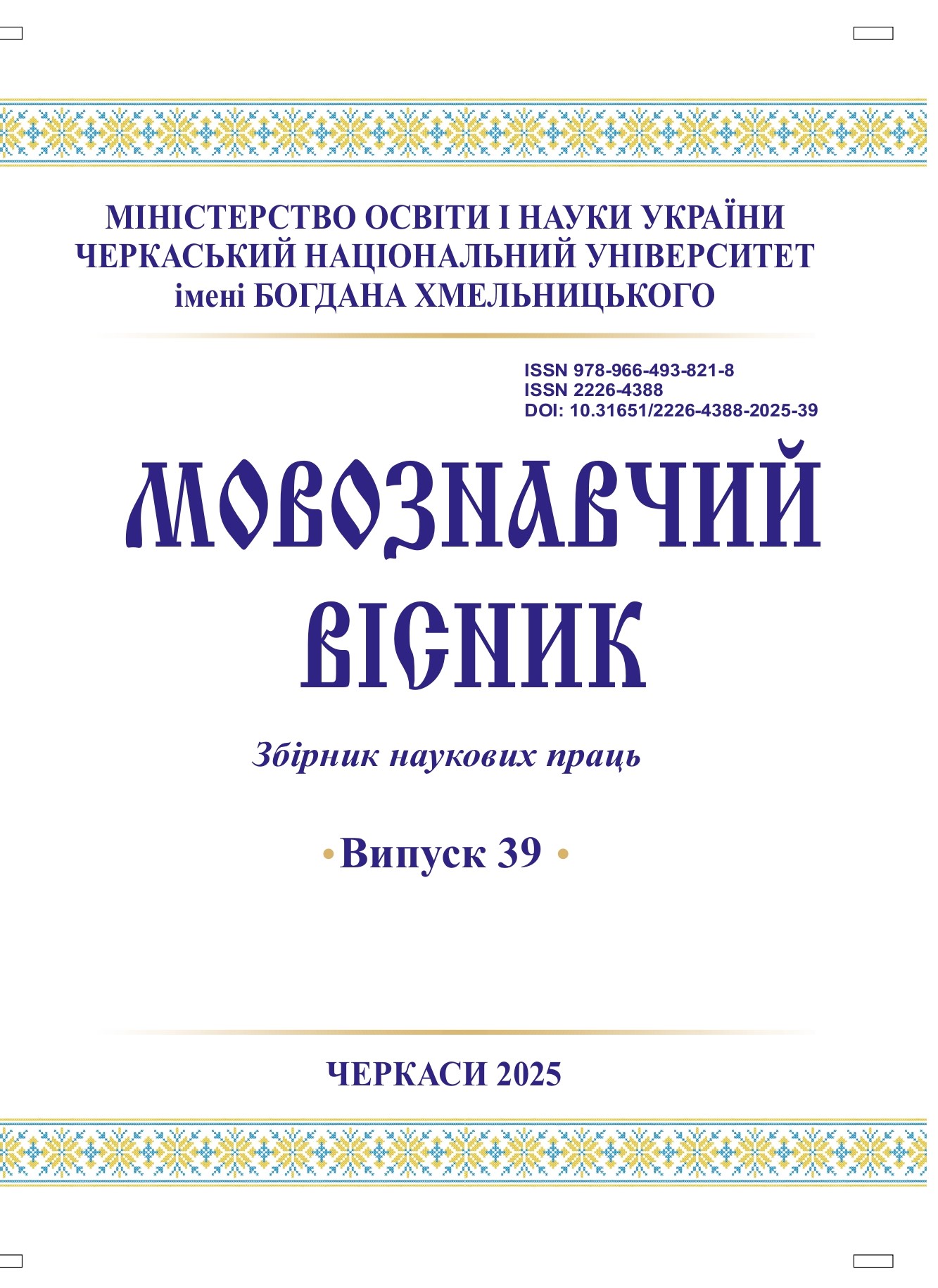
POLISH-UKRAINIAN FALSE FRIENDS OF THE TRANSLATOR IN BUSINESS LEXIS
Article Sidebar
Main Article Content
Abstract
Introduction. The article is devoted to a comprehensive analysis of Polish-Ukrainian false
friends of the translator within the framework of contemporary business and economic lexis. The relevance of the study is determined by the dynamic development of Polish-Ukrainian economic relations, the increasing volume of business documentation, and the growing demand for accurate translation of professional texts, where even minor lexical inaccuracies may lead to serious communicative, legal, or financial consequences. Particular attention is paid to lexemes that are formally similar in Polish and
Ukrainian but differ in meaning, scope of use, or stylistic and connotative characteristics.
The purpose of the study is to identify, systematize, and analyze Polish-Ukrainian false friends in business vocabulary, as well as to examine their semantic characteristics and translation difficulties in order to prevent errors in professional business communication.
The methods. The study employs analysis and synthesis of scholarly sources, the comparativetypological method for comparing lexical items, structural-semantic analysis to identify differences in meaning, as well as the contextual method.
Main results of the study. The article clarifies the concept of “false friends of the translator” in the
context of closely related languages and examines the main classifications of this phenomenon, including the distinction between absolute and relative false friends, as well as etymological and accidental ones.
Linguistic, cognitive-psycholinguistic, and sociolinguistic factors contributing to their emergence are analyzed, such as phonetic and graphic similarity, semantic divergence, morphological features, polysemy, and the influence of intermediary languages. Based on Polish-Ukrainian business texts and terminology, the study presents typical examples of translation errors, particularly in the use of lexemes such as aktualny / актуальний, faktura / фактура, premia / премія, nakłady / наклади, kontrola / контроль, and others.
Special attention is given to the role of contextual analysis, terminology verification, and the use of
specialized lexicographic and corpus resources in translation practice. The article concludes that
overcoming the problem of false friends in business discourse requires an integrated approach combining linguistic competence, critical thinking, and systematic, conscious handling of professional terminology.
Originality. The originality of this study lies in a systematic analysis of Polish-Ukrainian false friends within the domain of business lexis, with a focus on their semantic divergences and translation difficulties.
The research offers a structured classification of problematic lexical units and highlights their impact on professional business communication, contributing to the improvement of translation accuracy in the Polish–Ukrainian language pair.
Conclusions and specific suggestions of the author. The elimination of errors caused by “false
friends of the translator” in economic texts requires an integrated approach. Prospects for further research include expanding the corpus of Polish-Ukrainian business and economic texts in order to conduct a quantitative analysis of the frequency of false friends and typical translation errors. It is also advisable to develop thematically structured glossaries of Polish-Ukrainian false friends for specific subfields of economics (finance, accounting, marketing, EU law) and to investigate the effectiveness of their use in professional translation practice and in the educational process.
Article Details
References
Гарбовський М. Теорія перекладу. Київ : ВЦ «Академія», 2011. 432 с.
Корунець І. В. Вступ до перекладознавства. Київ : Либідь, 2008. 239 с.
Корунець І. В. Порівняльна типологія англійської та української мов. Київ : Вища школа, 2020. 284 с.
Корунець І. В. Теорія і практика перекладу. Вінниця : Нова книга, 2003. 448 с.
Мельничук О. С. Словник іншомовних слів. Київ : Наукова думка, 2005. 784 с.
Пелех А. Когнітивні аспекти міжмовної інтерференції у перекладі. Вісник ЛНУ. 2020. С. 70–78.
Чередниченко О. Український переклад: з минулого у сьогодення. Літературна мова у просторі національної культури. Київ, 2004. С. 88–97.
Czesak A. Fałszywi przyjaciele tłumacza w języku polskim i ukraińskim. Kraków: Wydawnictwo UJ, 2017. 215 s.
Gajda S. Językoznawstwo konfrontatywne i problemy przekładu. Warszawa : PWN, 2017. 278 s.
Grabowski Ł. Analiza kontekstowa fałszywych przyjaciół tłumacza w języku polskim. Opole : Uniwersytet Opolski, 2019. 180 s.
Grabowski Ł. False Friends in Polish–Ukrainian Translation: Cognitive and Pragmatic Aspects. Katowice : Uniwersytet Śląski, 2019. 122 p.
Maćkiewicz J. Semantyka i pragmatyka języka ekonomii. Gdańsk : Wydawnictwo UG, 2017. 240 s.
Siewert K. Fałszywi przyjaciele w przekładzie polskiej i niemieckiej terminologii prawnej i prawniczej. Comparative Legilinguistics. 2012. № 9. URL : https://cejsh.icm.edu.pl/cejsh/element/bwmeta1.element.ojs doi10_14746_cl_2012_09_04.
Venuti L. The Translator’s Invisibility. London : Routledge, 2017. 350 p. URL :
Słownik języka polskiego / SJP PWN. URL : https://sjp.pwn.pl.
Wielki słownik języka polskiego / WSJP PAN. URL : https://wsjp.pl.