
Requirements for the design of articles
1. We accept scientific articles with a volume of 10–15 pages (excluding abstracts and references; font – Times New Roman, size – 14, line spacing – 1.5, paragraph indent – 1 cm); the text volume may be increased by agreement with the editorial board. Page format – A4, orientation – portrait, margins: left – 3 cm, right – 1 cm, top and bottom – 2 cm. Text: font – Times New Roman, paragraph indent – 1 cm. If fonts other than Times New Roman are used in the article, they must be provided separately.
- Structure of a scientific article:
line 1 – UDC (left-aligned, bold);
line 2 – title of the scientific article (centered, bold, uppercase);
line 3 – initials and surname of the author (co-authors, bold); academic degree and academic title, place of work (position, name of the department, faculty, structural unit, higher educational institution, scientific institution, etc., where the author works), city and country of residence (bold italics), each co-author indicates information about themselves on a new line (centered);
line 4 – email address of the author / authors;
line 5 – ORCID identification number (http://orcid.org/) of the author / authors;
line 6 – Scopus-Author ID (indicated if there are indexed publications in Scopus);
line 7 – abstract; the volume of the abstract must be at least 150 words.
Structure and content of the abstract:
– purpose;
– scientific novelty;
– methodology;
– conclusions.
Methodology should be presented only if it contains novelty. The results of the work should be clearly and informatively described; the main theoretical and experimental results, factual data, revealed connections, and patterns should be provided. Preference should be given to new results and data of long-term significance, important discoveries, conclusions that refute existing theories, as well as data that, in the author's opinion, have practical value. Conclusions may contain recommendations, assessments, proposals, and hypotheses.
line 8 – keywords (words and phrases used to search for the article in electronic databases); they should be concise and reflect the content and specifics of the manuscript;
line 9 – beginning of the scientific article text; the text of the article must contain the elements listed below.
Relevance, highlighting the importance of the research, existing problems, and directions for their solution in the context of the set scientific tasks; unexplained aspects of the problem are named. Analysis of recent research and publications, providing a brief analysis of the results of research by scholars on the topic of the article. Research objective, formulating the goal and tasks of the scientific work. Materials and research methods, identifying the main methods and techniques applied in the scientific article. Research results and discussion, highlighting the obtained research results (if necessary). Conclusions and prospects, providing specific conclusions based on the research results and outlining prospects for further scientific research.
References contain a list of works in the order of mention or alphabetically. It is formatted according to the National Standard of Ukraine DSTU 8302:2015 “Information and documentation. Bibliographic reference. General provisions and rules of compilation” developed in 2015. It is mandatory to provide a DOI for sources that have this unique digital identifier. References to literature in the text of the scientific article should be provided in square brackets [1, p. 56; 7, pp. 45–51], and to primary sources – in parentheses.
List of sources used (if any) is formatted according to general requirements.
After this, a list of references in English (References) is provided, formed according to the international APA standard (used when placing manuscripts in foreign databases). This standard is INTERNATIONAL. Transliteration of Ukrainian characters must be in accordance with the Resolution of the CMU dated January 27, 2010, No. 55, and Russian characters – according to the BGN/PCGN system. Examples of formatting different types of sources according to the proposed standards are given below.
After the list of references, an abstract in English must be provided, containing information about the author, title, Abstract of the article in English (volume from 2000 to 3000 characters with spaces), and keywords. If the article is written in English, an extended abstract must be provided in Ukrainian.
The text should be typed without hyphenation. Illustrative material should be in italics, and analyzed units in illustrated sentences – in bold italics. Abbreviations like et al., XVI cent., initials with surnames (e. g., I. R. Vykhovanets), page indications (p. 34), names of settlements (m. Cherkasy, s. Helmiaziv) – through a non-breaking space (simultaneously pressing the keys Shift+Ctrl+Space).
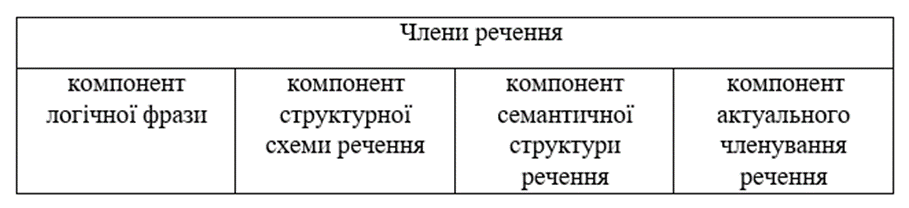
If the article contains fonts other than Times New Roman, it is necessary to provide them separately in electronic form. In the text, it is necessary to distinguish between a dash (–) and a hyphen (-). Copies of tables, diagrams, drawings, maps (electronic version mandatory) must be saved as separate files in RTF format. Tabular and graphical material can only be in portrait format. The table must have a sequence number, indicated on the right before the table title. The table title is placed above it in the center (font size – 14, bold, line spacing – 1.5). Table text is provided in Times New Roman (font size – 12, line spacing – 1). The width of the tables should be no more than 10.6 cm.
Table 1
Multidimensionality of sentence members
A figure must be a single graphic object, have a number and a title, which are indicated outside the object (font size – 14, bold, line spacing – 1, centered). The figure should be placed within the text. Figures must be high-contrast, either black and white or in color. Graphic materials must not be scanned.
Fig. 1. Figure title
Use “angle” quotes (guillemets) – «...»; for a quote within a quote, use double "curly" quotes: «“...”». Terms or semes should be enclosed in single quotes (‘ ’).
Notes and the list of abbreviations should be placed at the end of the article.
Materials must be submitted electronically in Microsoft Word format (.doc, .docx, .rtf). Information about the author (see Annex) should be provided in a separate file in .doc or .rtf format.
Authors without an Academic Degree must provide a review from their scientific supervisor or an extract from the department meeting minutes with a recommendation for publication.
Files should be named with the author’s surname in Latin characters. Examples: stattia_Martynova; vidomosti_Martynova; recenziya_Martynova.
The article must be signed by the author and submitted to the Editorial Board (Executive Secretary) via email: kumpl.kafedra@ukr.net.
The final decision on publication is made by the Editorial Board, which reserves the right to additional peer review, editing, or rejection of manuscripts.
Materials formatted in violation of the submission and styling requirements will not be considered by the Editorial Board.
Annex 2
Examples of Bibliographic Description
Single-author book:
DSTU 8302:2015
Городенська К. Г. Сполучники української літературної мови : [монографія]. Київ : Ін-т укр. мови НАН України ; Вид. дім Дмитра Бураго, 2010. 208 с.
APA Standard
Horodenska, K. H. (2010). Spoluchnyky ukrainskoi literaturnoi movy : monohrafiia [Connectors of the Ukrainian literary language]. Kyiv : In-t ukr. movy NAN Ukrainy ; Vyd. Dim Dmytra Burahо, 208 (in Ukr.).
Book with two or more authors:
DSTU 8302:2015
Слинько І. І., Гуйванюк Н. В., Кобилянська М. Ф. Синтаксис сучасної української мови. Проблемні питання. Київ : Вища школа, 1994. 670 с.
APA Standard
Slynko, I. I., Huivaniuk, N. V. & Kobylianska, M. F. (1994). Syntaksys suchasnoi ukrainskoi movy. Problemni pytannia [Syntax of the modern Ukrainian language. Problematic issues]. Kyiv : Vyshcha shkola, 670 (in Ukr.).
Edited and compiled books:
DSTU 8302:2015
Сучасна українська літературна мова / за заг. ред. А. П. Грищенка. Київ : Вища школа, 1997. 493 с.
Говірки Черкащини : збірник діалектних текстів / упорядн.: Г. І. Мартинова, Т. В. Щербина, А. А. Таран. Черкаси, 2013. 870 с.
APA Standard
Grishchenko, A. P. (Ed.) (1997). Suchasna ukrainska literaturna mova [Мodern Ukrainian literary language]. Kyiv : Vyshcha shkola, 493 (in Ukr.).
Martynova, G. I., Shcherbyna, T. V. & Taran, A. A. (Conductors) (2013). Govirku Cherkaschunu : zbirnuk dialektnuh tekstiv [Dialects of Cherkasy region : Collection of dialectal texts]. Cherkasy, 870 (in Ukr.).
Multi-volume edition / separate volume:
DSTU 8302:2015
Атлас української мови. В 3-х т. Т. 2. Волинь, Наддністрянщина і суміжні землі. Київ : Наук. думка, 1988. 520 с.
Словник української мови. В 11 т. / ред. кол. : І. К. Білодід (голова) та ін. Київ : Наукова думка, 1970–1980. Т. 2. 1971. 550 с.; Т. 5. 1974. 840 с.; Т. 7. 1976. 723 с.; Т. 9. 1978. 916 с.; Т. 11. 1980. 699 с.
APA Standard
Atlas ukrayinskoyi movy (1988). [Atlas of the Ukrainian language]. V 3 t. T. 2. Volyn, Naddnistryanshchyna i sumizhni zemli. Kyiv : Naukova dumka, 520 (in Ukr.).
Bilodid, I. K. (Ed.) ta in. (1970–1980). Slovnyk ukrainskoi movy [Dictionary of the Ukrainian Language]. V 11 t. T. 2, 5, 7, 9, 11. Kyiv : Naukova dumka (in Ukr.).
Journal articles:
DSTU 8302:2015
Арібжанова І. Зміст і форма члена речення. Українське мовознавство. 2010. № 40. С. 48–56.
APA Standard
Aribzhanova, І. (2010). Zmist i forma chlena rechennia [Form and content of a part of a sentence]. In : Ukrainske movoznavstvo [Ukrainian linguistics], (40), 48–56 (in Ukr.).
Collections of scientific papers:
DSTU 8302:2015
Лесюк М. П. Дослідження словотвору на рівні словотвірних гнізд. Вісник Прикарпатського національного університету імені Василя Стефаника. Філологія. Івано-Франківськ : ВДВ ЦІТ, 2007. Вип. ХV–ХVІІІ. С. 212–216.
Habrajska G. Nakłanianie, perswazja, manipulacja językowa. Acta Universitatis Lodziensis. Folia Litteraria Polonica. 2005. 7. S. 91–126.
APA Standard
Lesiuk, M. P. (2007). Doslidzhennia slovotvoru na rivni slovotvirnykh hnizd [Study of word formation at the level of word-forming nests]. In : Visnyk Prykarpatskoho natsionalnoho universytetu imeni Vasylia Stefanyka. Filolohiia [Bulletin of the Vasyl Stefanyk Precarpathian National University. Philology]. Ivano-Frankivsk : VDV TsIT. Vyp. ХV–ХVІІІ, 212–216 (in Ukr.).
Habrajska, G. (2005). Nakłanianie, perswazja, manipulacja językowa [Induction, persuasion, language manipulation]. In : Acta Universitatis Lodziensis. Folia Litteraria Polonica, 7, 91–126 (in Pol.).
Conference abstracts and proceedings:
DSTU 8302:2015
Калько М. І. Концептуалізація часу у творчості М. Семенка. Матеріали Міжнародної заочної науково-практичної конференції «Актуальні напрями сучасної філології». Одеса, 2017. С. 81–84.
APA Standard
Kalko, M. I. (2017). Konceptualizaciya chasu u tvorchosti M. Semenka [Conceptualization of time in the work of M. Semenko]. In : Materialy Mizhnarodnoi zaochnoi naukovo-praktychnoi konferentsii «Aktualni napriamy suchasnoi filolohii» [Proceedings of the International correspondence scientific-practical conference «Current directions of modern philology»]. Odesa, 81–84 (in Ukr.).
Dissertations and abstracts of dissertations:
DSTU 8302:2015
Наливайко Ю. Ю. Синкретизм у системі членів речення : дис. ...канд. філол. наук : 10.02.01 / Донецький національний ун-т. Донецьк, 2007. 216 с.
Наливайко Ю. Ю. Синкретизм у системі членів речення : автореф. дис. …канд. філол. наук : 10.02.01 / Дніпропетровський національний ун-т. Дніпропетровськ, 2007. 20 с.
APA Standard
Nalyvaiko, Yu. Yu. (2007). Synkretyzm u systemi chleniv rechennia. [Syncretism in the system of sentence members]. PhD dissertation (Ukrainian language). Donetsk, 216 (in Ukr.).
Nalyvaiko, Yu. Yu. (2007). Synkretyzm u systemi chleniv rechennia. [Syncretism in the system of sentence members]. Extended abstract of PhD dissertation (Ukrainian language). Dnipropetrovsk, 20 (in Ukr.).
Electronic resources (Online sources):
DSTU 8302:2015
Державний комітет статистики України. URL : http://uga-port.org.ua/sites/default/files/bl_posiv_2013.pdf.
Олексенко В. Дуплексив як один з основних способів реалізації семантико-синтаксичного синкретизму у межах простого речення. Materialy VII mezinarodni vedecko-prakticka conference «Vedecky prumysl evropseho kontinentu-2011». Praha, 2011. P. 13–23. URL : http://ekhsuir.kspu.edu/bitstream/123456789/721/1/.
APA Standard
Derzhavnyi komitet statystyky Ukrainy [State Statistics Committee of Ukraine].
Oleksenko, V. (2011). Dupleksyv yak odyn z osnovnykh sposobiv realizatsii semantyko-syntaksychnoho synkretyzmu u mezhakh prostoho rechennia [Duplex as one of the main ways to implement semantic-syntactic syncretism within a simple sentence]. In : Materialy VII mezinarodni vedecko-prakticka conference «Vedecky prumysl evropseho kontinentu-2011». Praha, 13–23. Available at : http://ekhsuir.kspu.edu/bitstream/123456789/721/1/ (in Ukr.).
Annex 3
Sample of Article and Reference List Formatting
УДК 811.161.2.81’373.47
ФУНКЦІЙНО-СЕМАНТИЧНЕ ПОЛЕ ЯКОСТІ В ДІАЛЕКТНИХ ТЕКСТАХ
Г. І. Мартинова, доктор філологічних наук, професор
кафедри українського мовознавства і прикладної лінгвістики,
Черкаський національний університет імені Богдана Хмельницького
e-mail: ganmart@meta.ua
ORCID: http://orcid.org/0000-0002-8033-075X
Т. В. Щербина, кандидат філологічних наук, доцент
кафедри українського мовознавства і прикладної лінгвістики,
Черкаський національний університет імені Богдана Хмельницького
e-mail: Tanya_Bevz@i.ua
ORCID: http://orcid.org/0000-0003-0008-5983
Abstract:
– purpose (text);
– scientific novelty (text);
– methodology (text);
– conclusions (text).
Keywords:
Body of the Article
Relevance. Text.
Analysis of recent research and publications. Text.
Research objective. Text.
Materials and research methods. Text.
Research results and discussion. Text.
Conclusions and prospects. Text.
List of Abbreviations References
ГПК – Говірки Південної Київщини : Збірник діалектних текстів / Упорядники Г. І. Мартинова, З. М. Денисенко, Т. В. Щербина. Черкаси : ПП Чабаненко Ю.А., 2008. 370 с.
ГЗП – Говірки Західної Полтавщини : Збірник діалектних текстів / Упорядник Г. І. Мартинова. Черкаси : ПП Чабаненко Ю. А., 2012. 325 с.
ГЧ – Говірки Черкащини : Збірник діалектних текстів / Упорядники Г. І. Мартинова, Т. В. Щербина, А. А. Таран. Черкаси : ПП Чабаненко Ю. А., 2013. 870 с.
References
- Бобер Т. Б. Назви одягу взуття та прикрас із середньонаддніпрянських говірок: структура, принципи номінації, просторове варіювання дис. … док. філософії : 03 Гуманітарні науки, 035 Філологія. 2021. 404 с.
- Бойко Н. Діалектна експресивна лексика: проблеми семантики. Мовознавчий вісник: зб. наук. праць / Відп. ред. Г. І. Мартинова. Черкаси : Вид. відділ ЧНУ, 2011. Вип. 12–13. С. 84–87.
- Висоцький А. В. Склад та структура лексико-семантичних груп якісних прикметників в українській мові : автореф. дис. ... канд. філол. наук : 10.02.01 / Нац. пед. ун-т ім. М. П. Драгоманова. Київ, 1998. 18 с.
References
- Bober, T. B. (2021). Nazvy odiahu vzuttia ta prykras iz serednonaddniprianskykh hovirok: struktura, pryntsypy nominatsii, prostorove variiuvannia [Names of clothes, shoes and jewelry from middle-upper-Dnieper dialects: structure, principles of nomination, spatial variation]: PhD dissertation (Ukrainian language). Cherkasy, 404.
- Boiko, N. (2011). Dialektna ekspresyvna leksyka: problemy semantyky [Dialect expressive vocabulary: problems of semantics]. In : Movoznavchyi visnyk: zb. nauk. prats [Linguistic Bulletin: coll. of science works]. Cherkasy: Vyd. viddil ChNU. Vyp.12–13, 84–87 (in Ukr.).
- Vysotskyi, A. V. (1998). Sklad ta struktura leksyko-semantychnykh hrup yakisnykh prykmetnykiv v ukrainskii movi [Composition and structure of lexical-semantic groups of qualitative adjectives in the Ukrainian language]: Extended abstract of PhD dissertation (Ukrainian language). Kyiv, 18 (in Ukr.).
FUNCTIONAL-SEMANTIC FIELD OF QUALITY IN DIALECT TEXTS
Hanna Martynova, Doctor of Philological Sciences, Professor of the
Department of Ukrainian Linguistics and Applied Linguistics,
Bohdan Khmelnytsky National University of Cherkasy
e-mail: ganmart@meta.ua
ORCID: http://orcid.org/0000-0002-8033-075X
Tetyana Shcherbyna, Candidate of Philological Sciences, Associate Professor
of the Department of Ukrainian Linguistics and Applied Linguistics,
Bohdan Khmelnytsky National University of Cherkasy,
boulevard Shevchenko, 81, Cherkasy, Ukraine, index 18031
e-mail: Tanya_Bevz@i.ua
ORCID: http://orcid.org/0000-0003-0008-5983
English Abstract
Аbstract. Introduction.
The purpose.
The methods.
Main results of the study.
Originality.
Conclusions and specific suggestions of the author.
Key words:
Important Note! In light of recent events, articles must not contain citations (and the reference list must not include sources) referring to works from Russia or Belarus. Exceptions are made only in cases justified by historical necessity.